BeePeeking
  • Blog
  • Portfolio
  • Biodiversity
  • Biophilia
  • Go Organic
  • About
  • Vision
  • Resources

BeePeeking

6/19/2017

0 Comments

 
Picture
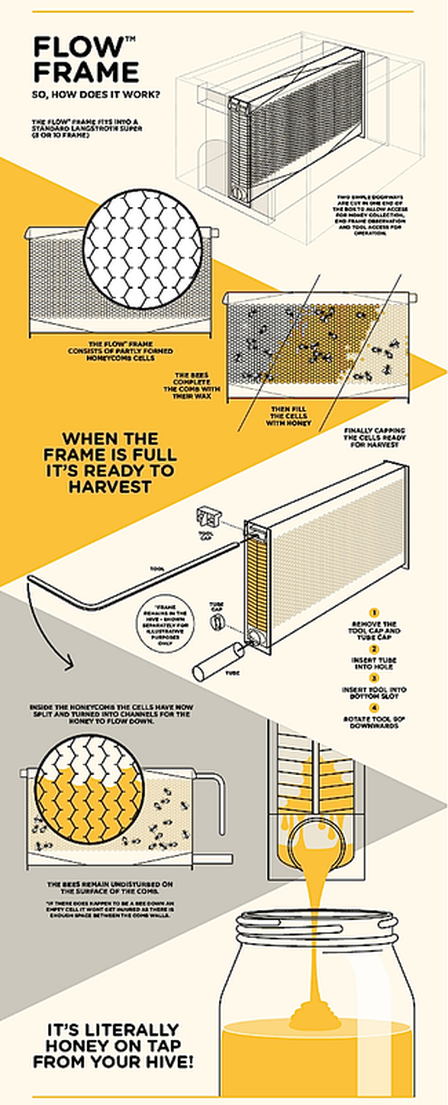
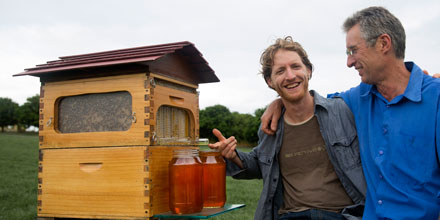
Our Flow Hive has an observation window, which is SO cool. 
Picture
I tried something new this year: I put TWO upper entrances on the Flow hive; this gives the girls two separate pathways straight into the Flow deep with their nectar and pollen and seems to be more efficient for everyone. We are just running one hive this year, as we lost a queen in early June and decided to just combine them rather than re-queen so late. They are going strong! Looking forward to our first Flow Hive harvest this summer.
Best review of the Flow Hive: by Hillary of Girl Next Door Honey
Picture
Picture
      BeePeeker 2017
Fresh cut-comb honey
0 Comments

Earth Day 2017=Bee Day in our apiary

4/22/2017

0 Comments

 
Picture
Our two new hives are thriving in spite of the rainy cool weather. We started them both with several frames of honey, and they have been bringing in pollen like crazy for the new brood. Pollen is coming in from many sources including epimedium, forget-me-not, and arugula.
Picture
 Here you can see pollen stores for the larvae, as well as capped brood and new honey. We installed the bees on April 2, so the first batch of babees should be hatching this week. We are running one regular hive and one FLOW hive this year, so stay tuned.
0 Comments

Easiest Installation Ever=Happy HoneyBees

3/7/2017

0 Comments

 
Hello beekeepers,
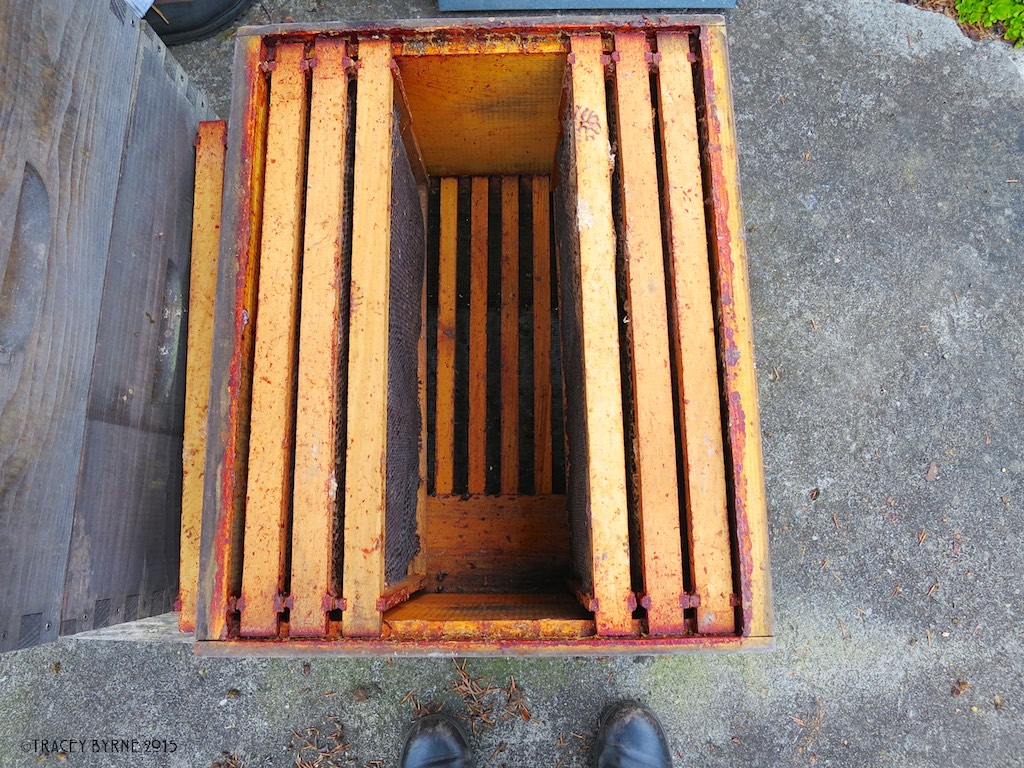
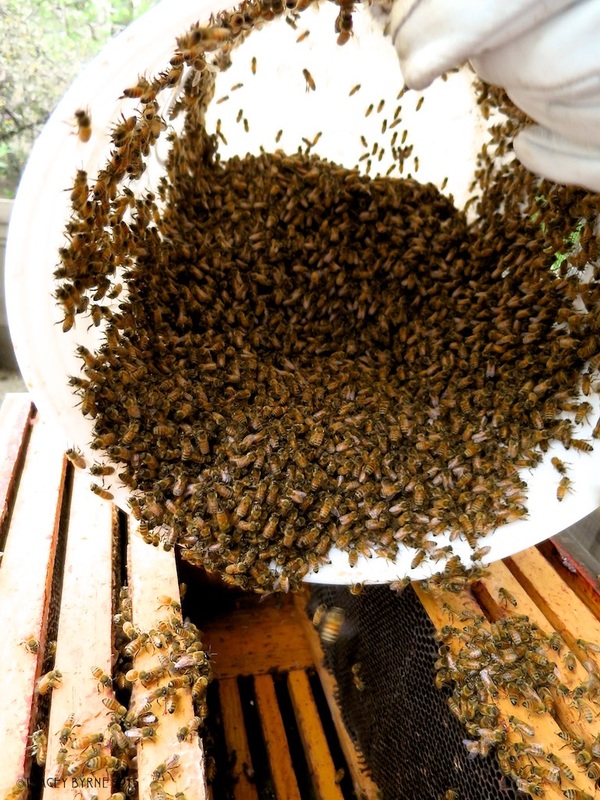
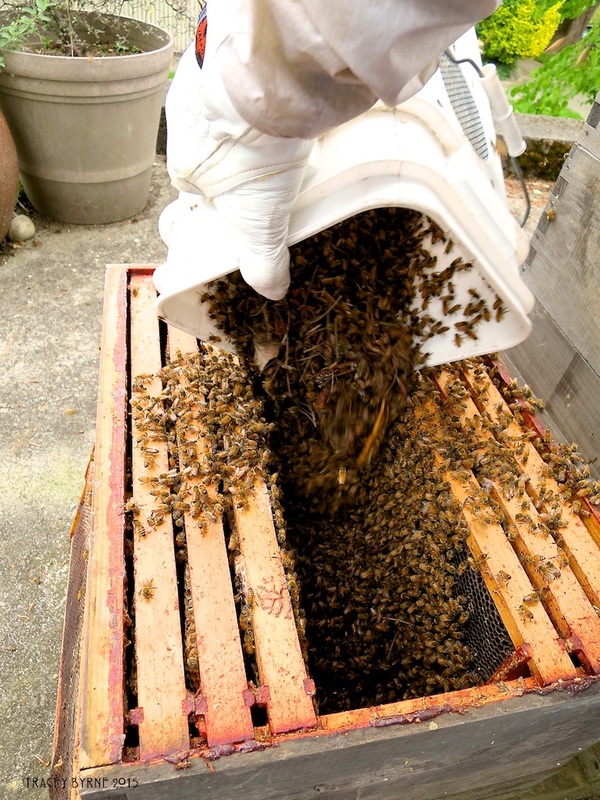
I wanted to share with you the gentlest and most elegant way to install a package of bees into your beehive. If you have ever shaken honeybees out of their box, you know it is both exciting and a bit frightening, but it also is a little rough on the bees. We have been employing this new, improved strategy for the last several years, and hope you will give it a try.

First, we readied each hive by putting two frames of honey into each deep, along with the already built-out frames in our two empty hives. Then we just removed the can of syrup (no longer needed) and carefully placed the queen in her little cage and the open box of bees into each hive (having first removed the cork on the queen cage and replaced it with a bit of marshmallow). We then put the lid on and give the bee-girls a couple days to release the queen, and Voila! Happy Bees.

What a lazy way to load the hives. We loved it.
Picture
Package of bees, waiting to be installed
Picture
Package on its side; queen cage and syrup removed
Picture
Ready for the cover: let rest for two days
0 Comments

BeePeeking Flow Hive Update

6/5/2016

0 Comments

 
Picture
I am excited to report that we have our FLOW hive up and running. As you can see in the photo above, the bees are checking out the new system. We have four FLOW frames in the middle of the deep, with two cut-comb honey deeps on each side. Right on schedule, the bees are beginning to wax up the cracks and we look forward to seeing them fill the frames with honey.

We are trying out a couple new things this year: in addition to running one FLOW hive, we have purchased deeps from Denmark; our goal is to keep our bees more cozy through the damp winter.
Picture
Picture
Hives from the front: Danish Swienty deeps
Hives from the back, overlooking the street
Picture
Meanwhile, looking in the side peek-a-boo window, the bees are busy drawing out traditional comb, and loading it up with nectar. An unexpected perk: we now have an observation hive, and can watch the bees in action with minimal disturbance. In just two days the workers drew out the second comb and have almost filled both with nectar. We are simply entranced with the show.
Picture
In this image, you can see the bees drawing out beautiful wax honey comb
Picture
This image is from the brood chamber (in the Sweinty deep); you can see that the queen has been busy.
0 Comments

Bumblebee, honeybee, or Wasp?

3/5/2016

1 Comment

 
Picture
The Difference Between Honeybees and Bumblebees
 
Did you know that there are more than 4500 species of bees that live in the US and Canada, and worldwide over 20,000 species have been identified?
 
Many urban dwellers have not had enough experience with backyard pollinators to easily tell the difference between bees and wasps. For me, it is similar to how you can tell a cat from a dog, or robin from a spotted towhee–not only do they look different, but their movements and habits are unique.

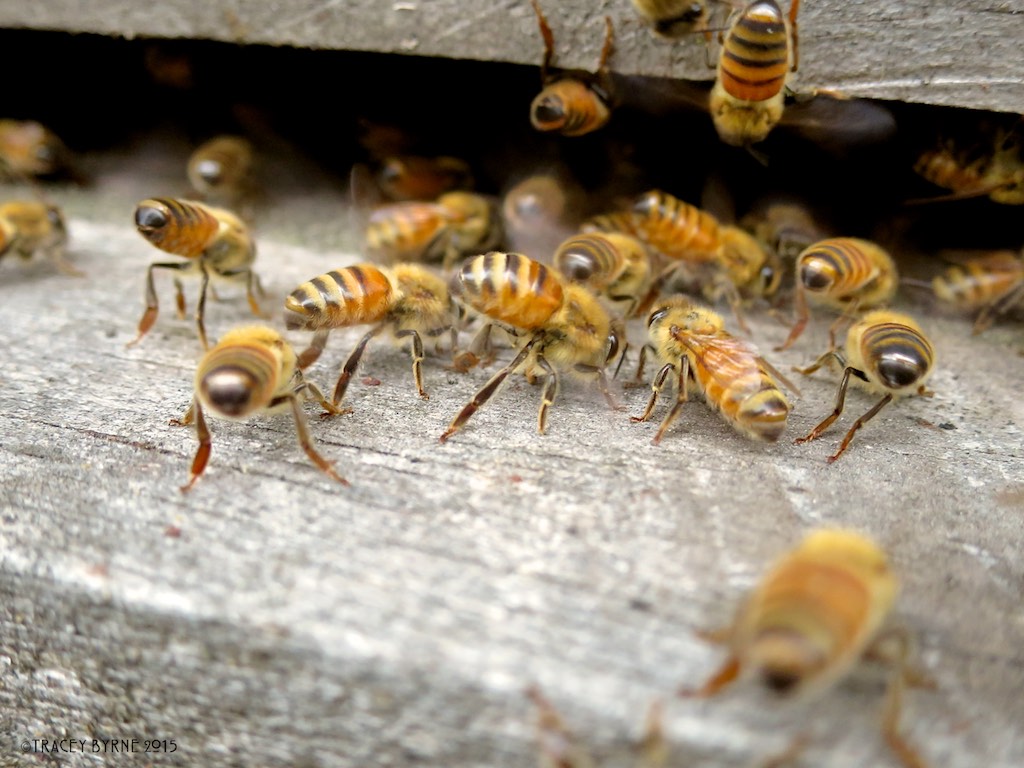
You can often ID your backyard bugs by where you find them and what activity they are engaged in. You will find medium-sized golden-brown to black honeybees (photos right) busy flying back and forth between flowers, loading up on pollen and nectar, and zipping back to their hive. Bumblebees (photos left) are generally larger and fuzzier that the honeybee, many with black, orange, or yellow stripes. I consider bumblebees to be the “teddy-bear” of bees, and the most photogenic. Honeybees tend to be sleeker and less hairy than the bumblebees, but both carry pollen on their back legs.
Picture
Picture
Picture
Bumbleebees stage left & honeybees stage right
Picture

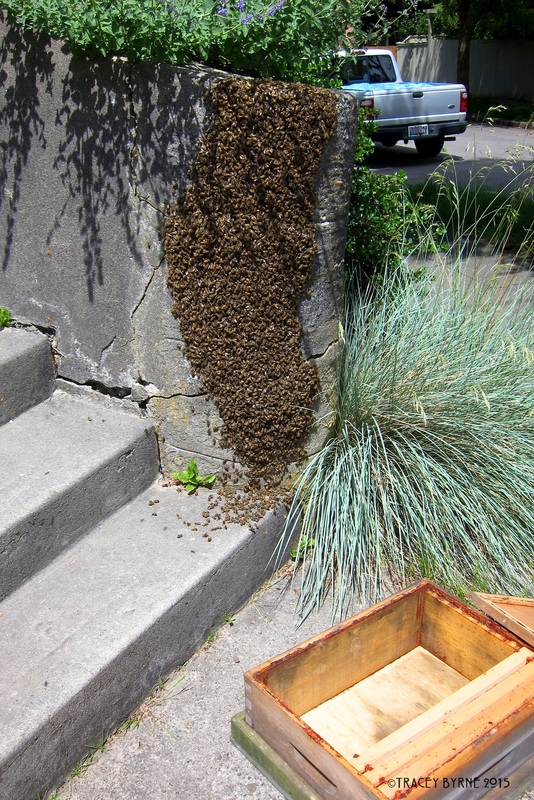
Honeybee Swarm
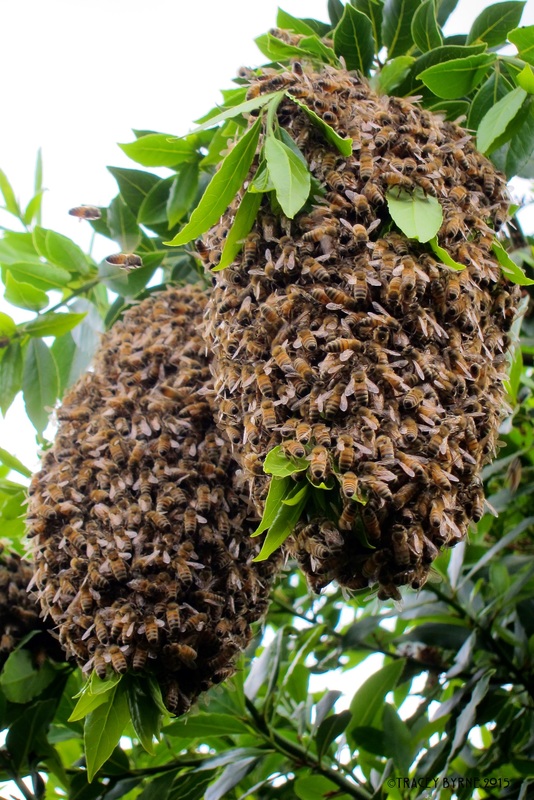
Swarming honeybees are docile; they have nothing to protect–as they are merely scoping out the real estate in your neighborhood. The honeybee swarm consists of a healthy queen and upwards of about 10,000 of her workers. Call your local poison-free bee-guy to come collect them, and they will be relocated to a good home.
Picture
Of all the bees, we know the most about our domesticated non-native European honeybees, not only for their pollination efforts but also for the food, candles, and medicinal products derived from their honey, pollen, wax, propolis, and venom. Honeybees are the outliers in the bee family. They, along with bumblebees, are social insects, which means that they work together in the hive to raise their young and make honey. Most other bees are solitary, do not care for their offspring, and a whopping 70% of all bees live in the ground.
Picture
Bumblebee nests can be found in the ground, in abandoned birdhouses, or in attics. Their nests are nothing like the honeybee's neat and tidy honeycomb (top); instead, they look really primitive, and a bit cobbled together (below).  The bumblebee queen hibernates over the winter, so bumblebees need gather only enough nectar and pollen to raise the brood each season. Honeybees must store enough honey and pollen to allow the workers and queen to survive the winter.
Picture

Bee or Wasp?
Bees: fuzzy, friendly, busy-but not aggressive, flight patterns are direct. Variations in size and color from golden brown to green to black, thick legs with pollen baskets, nectar gatherers; nest in ground, woodpiles, hives, attics, and walls.

Wasps and hornets: often aggressive, many carnivorous, striking yellow-black or white-black pattern that shouts CAUTION! Shiny, long thin legs (no fuzz or pollen basket-), wasp-waist, annoying at picnics, zig-zag flight pattern, paper nests found in trees or under eaves.
Picture
poster by Alex Surcica
Picture
Want to know more? Check out the book "The Bees in Your Backyard" by Wilson and Carril; for a peek inside my beehives, and more images of the wild things that visit my backyard click here.
1 Comment

Honeybees & Pollen 

2/13/2016

0 Comments

 
Narrated by Cedar Anderson, the inventor of the FLOW hive.
Bonus double-feature for you today :^) also from Flow.
Enjoy!
0 Comments

Neonics: Bad for everyone

12/28/2015

1 Comment

 
 Re-posted from the Center for Food Safety

Popcorn's Dirty Secret" won the 2015 Digital Edge award!
It’s no secret we love popcorn. We Americans consume more than 16 billion quarts of popcorn each year. But we’re getting more than we bargained for in all those bowls of popcorn: bee-toxic pesticides.

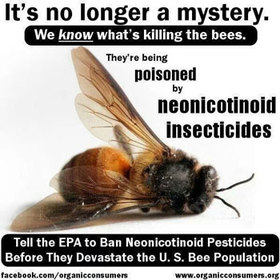
Bees are dying at alarming rates, and scientists have identified a group of insecticides called neonicotinoids (“neonics”) as a prime culprit in these drastic population losses. The largest single use of neonicotinoids is as a seed coating for field crops (like corn, soy, canola, and wheat). In fact, researchers estimate that 95-99% of all field corn grown in the U.S. comes from seed coated with bee-toxic neonic chemicals.

Neonics are the most widely used insecticides in the world. What makes them different from most pesticides is that they are systemic chemicals, meaning they are dispersed throughout the treated plant, rendering the whole plant toxic. Just as alarming, neonics are shown to last in the environment for years, harming species that the chemical was not designed to kill – like bees, butterflies, birds, and other helpful insects.

Unfortunately, the popcorn industry uses bee-killing chemicals on their seeds, too.  That’s why we’re calling on Pop Secret, one of the biggest brands in the industry, to urge them to source their popcorn from seeds that are NOT coated in these harmful chemicals.

Pop Secret would not be alone in taking action against neonics:
  • Pop Weaver has already agreed to a phase-out of neonics.
  • To date, more than 4 million Americans have called on the government to take stronger actions to protect bees from toxic pesticides like neonicotinoids.
  • The U.S. Fish and Wildlife Service will implement a ban on neonicotinoid insecticides on all wildlife refuges nationwide by January 2016.
  • The European Union instituted a moratorium on the most toxic uses of neonicotinoids.
  • The Province of Ontario, Canada has announced plans to reduce the number of acres planted with neonicotinoid-coated corn and soybean seeds by 80 percent by 2017.
  • Although it is currently difficult to obtain non-coated seeds in the U.S., growers in Canada requested and received non-treated seed, proving that it is possible to diversify the seed supply with non-coated options when companies and growers are willing to demand it.
  • Given the countless risks, lack of benefits, and widespread consumer demand for pollinator protection, it’s time for Pop Secret to join Pop Weaver and commit to phasing out the use of neonic-coated seeds for their popcorn. Mythbusting and True Cost
  • Learn more about the insidious nature of neonics and what you can do; take action here: pollinatorsandyourplate.org
                                              
The American Bird Conservancy reports that "a single corn kernel coated with a neonicotinoud can kill a songbird", and the Center for Food Safety reports that they are polluting our water systems too.
Picture
  It is ironic to think that man might determine his own future by something so seemingly trivial as the choice of an insect spray. - Rachel Carson, Silent Spring
Picture
1 Comment

Autumn Equinox & Bees in Borage

9/26/2015

1 Comment

 
Picture
Picture
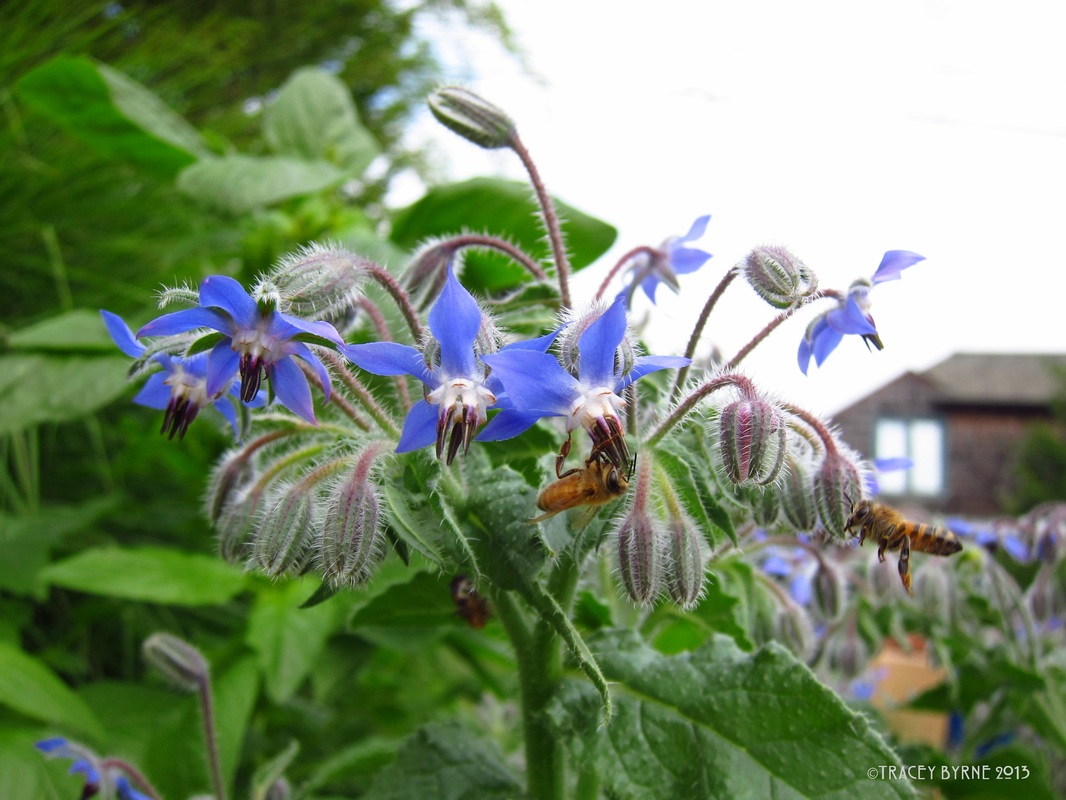
Our honeybees were abuzz on equinox, gathering pollen and nectar from the borage; I decided to gather borage blossoms as well, for our salad and tea. Not only beautiful, but good for you too.
1 Comment

Autumn BeePeeking

9/12/2015

2 Comments

 
Picture
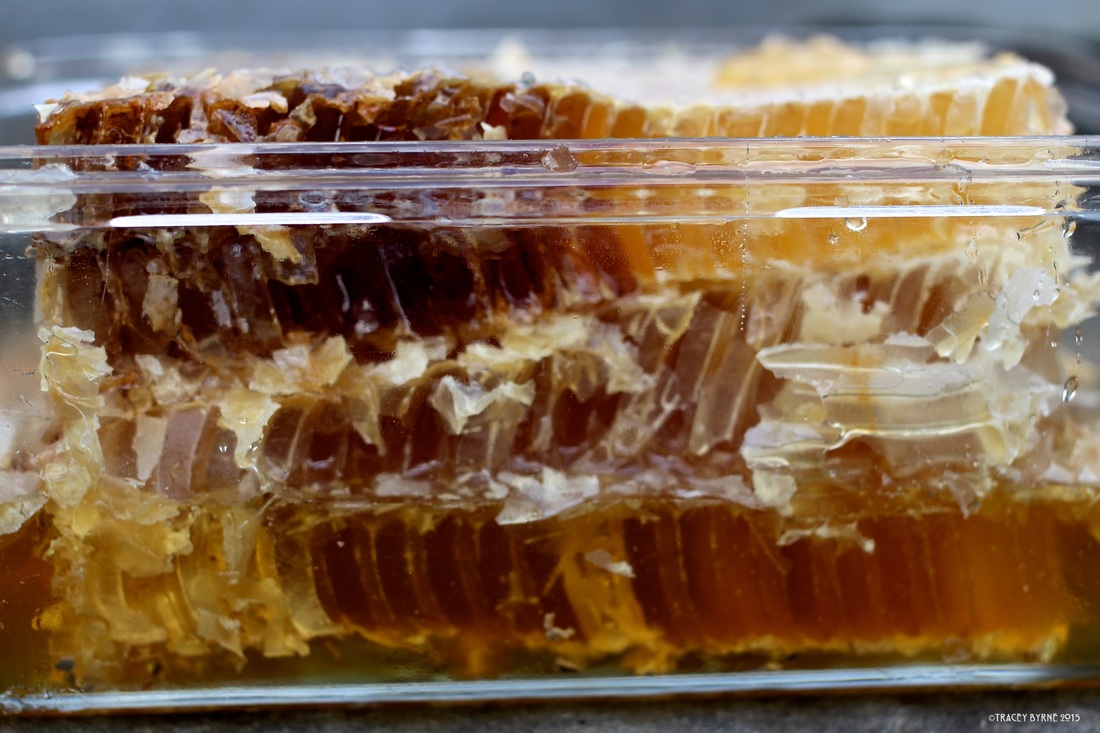
We had four strong hives all season (though one of our hives swarmed in late summer and left us queenless.) Our bees have plenty of honey to get through the winter, so we have harvested one medium (10 frames) of beautiful cut-comb honey. Thank you bees!

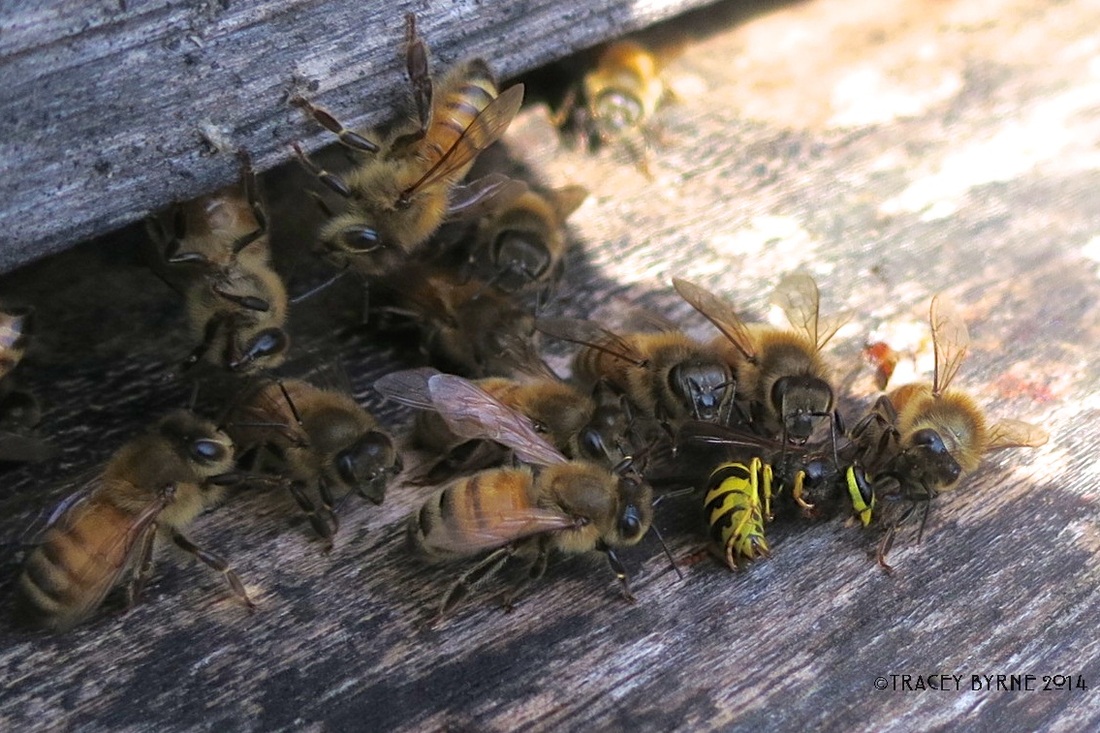
The bees and I have been battling yellowjackets, which are invading one hive and eating bees, honey, pollen, and larvae; when large numbers of yellowjackets have stormed the gates it is difficult for even a strong hive to recover.

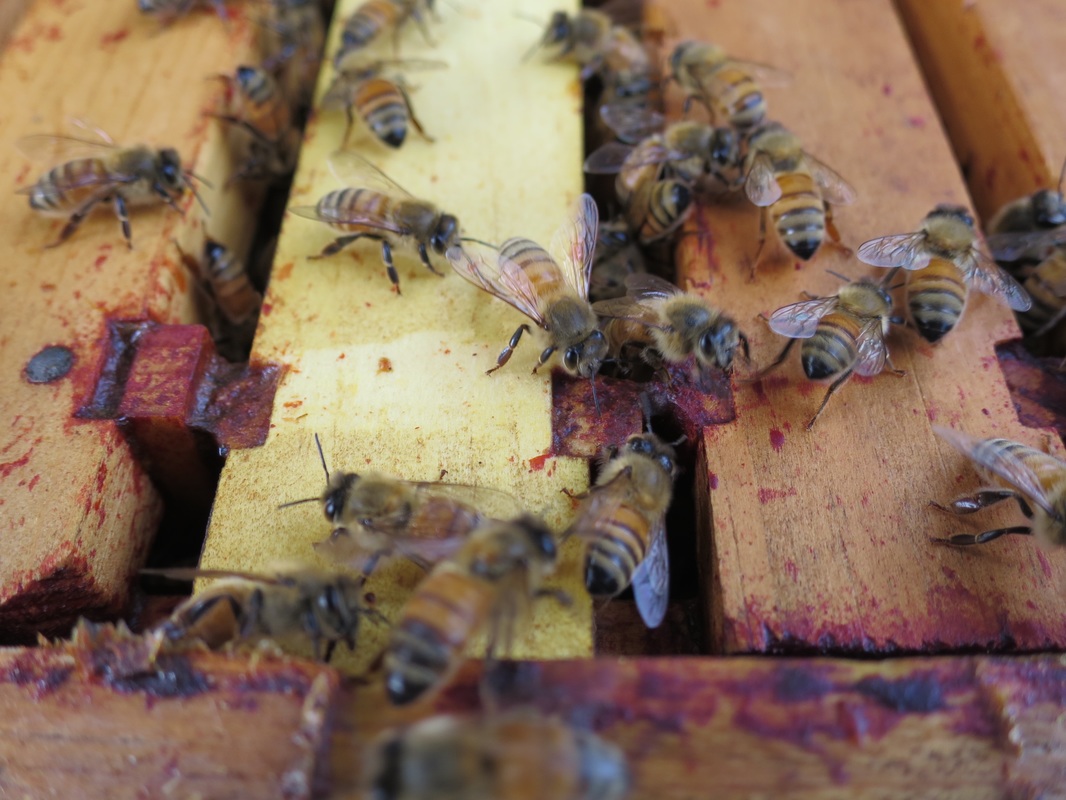
That red stuff in the image below is propolis, which the bees make from tree sap. Honeybees use propolis to seal up the cracks in the hive, and it is an antibacterial. Humans have used propolis to treat infections and wounds since ancient times and recent studies show that it is resistant to MRSA.
Methicillin-resistant Staphylococcus aureus (MRSA) infection is caused by a type of staph bacteria that has become resistant to many antibiotics used to treat ordinary staph infections. Honeybees are not only important pollinators of crops–they also supply us with superfoods and medicinals.
Picture
2 Comments

More on the Plight of the Honeybee

7/10/2015

0 Comments

 
Picture
This little film is a powerful statement of what is wrong with our regulatory system.

Veteran Colorado beekeeper Tom Theobald uncovered EPA memos that dealt with the long-term consequences of using clothianidin, a neonicitinoid, on the life cycle of the honeybee.

Tom writes, "Do We Have A PESTICIDE BLOWOUT? Clothianidin is agriculture‛s Deep Water Horizon. America‛s farmland is awash in questionable chemicals as surely as the shorelines of the Gulf Coast are awash in crude oil – and for many of the same reasons."
Picture

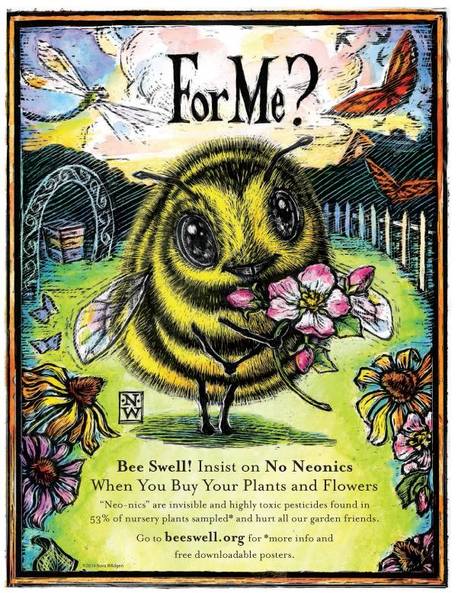
What can you do to protect honeybees and all native bees and pollinators?
Do not buy flowering plants that have been treated with neonics
Support local & organic beekeepers
:::::
Free Posters courtesy of Nora Wildgen at BeeSwell
0 Comments
<<Previous
Forward>>

    RSS Feed

    Author

    Tracey Byrne~

    I taught K-12 students from north of the Arctic Circle to the Puget Sound Ecoregion, garnering  40 years of experience as a classroom teacher, learning mentor, and private tutor. 

    I spent most of the 1980s and 90s in Alaska flying airplanes, floating wild rivers, winter camping, teaching, parenting, and living off the grid. 

    Here in Seattle, I am an advocate for environmental stewardship, place-based education, and outdoor play. I share my enthusiasm for birds, bugs, and backyards and have been a featured writer and photographer for Pacific Horticulture. 
    ​

    All photographs © T. Byrne unless otherwise noted.

    Picture
    Professional Reader

    Categories

    All
    Adventuring
    Amphibians
    Artists
    Beekeeping
    Biophilia
    Birds
    Bumblebees
    Citizen Science
    Cool Bugs
    Environmental Issues
    Flow Hive
    Fungi
    Gardening
    GMO
    Good Reads
    Guest Post
    Honeybee
    Infographic
    Organics
    Pesticides
    Pollinator
    Sky Matters
    Why
    Youtube Videos


    Archives

    July 2026
    June 2026
    March 2026
    December 2025
    November 2025
    October 2025
    September 2025
    August 2025
    July 2025
    June 2025
    April 2025
    November 2024
    June 2024
    April 2024
    February 2024
    December 2023
    November 2023
    September 2023
    June 2023
    April 2023
    March 2023
    January 2023
    December 2022
    October 2022
    August 2022
    July 2022
    April 2022
    March 2022
    February 2022
    January 2022
    December 2021
    September 2021
    May 2021
    April 2021
    March 2021
    February 2021
    December 2020
    November 2020
    October 2020
    September 2020
    August 2020
    June 2020
    May 2020
    April 2020
    February 2020
    January 2020
    December 2019
    October 2019
    September 2019
    July 2019
    June 2019
    May 2019
    April 2019
    February 2019
    January 2019
    December 2018
    November 2018
    October 2018
    September 2018
    August 2018
    July 2018
    June 2018
    May 2018
    April 2018
    March 2018
    February 2018
    January 2018
    December 2017
    November 2017
    October 2017
    September 2017
    August 2017
    July 2017
    June 2017
    May 2017
    April 2017
    March 2017
    February 2017
    January 2017
    December 2016
    September 2016
    August 2016
    July 2016
    June 2016
    May 2016
    April 2016
    March 2016
    February 2016
    January 2016
    December 2015
    November 2015
    October 2015
    September 2015
    August 2015
    July 2015
    June 2015
    May 2015
    April 2015
    March 2015
    February 2015
    January 2015
    December 2014
    November 2014
    October 2014
    September 2014
    August 2014
    July 2014
    June 2014
    May 2014
    April 2014
    March 2014
    February 2014
    January 2014
    December 2013
    November 2013
    October 2013
    August 2013